
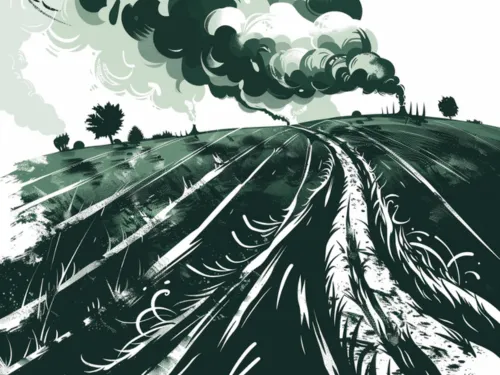


Causes of deforestation
Agricultural expansion
A significant cause of deforestation is agricultural expansion, which includes activities like cattle ranching and palm oil plantations.
Countries like Brazil, China, and India face a high demand for agricultural products, leading to the conversion of forests into farmland.
Cattle ranching, in particular, has led to widespread deforestation in Brazil, as forests are cleared for grazing and fodder production.
Timber harvesting
Illegal logging and timber harvesting also contribute significantly to deforestation.
Illegal logging is a major issue responsible for forest degradation.
Timber-intensive industries in countries like China and India drive the demand for wood, leading to the depletion of forests for timber and paper products.
Infrastructure development
Seemingly unrelated activities like infrastructure development can also lead to deforestation.
The construction of roads, highways, and cities results in the clearing of forests to make land available for these purposes.
As countries like India and China experience economic growth and urbanisation, an increasing demand for infrastructure leads to deforestation.
Environmental consequences
Loss of biodiversity
Deforestation leads to a significant decline in biodiversity, as it destroys the habitats of countless plant and animal species.
Tropical forests, particularly rainforests, are home to an astounding variety of biodiversity. As these habitats are destroyed, many species struggle to survive, resulting in a loss of wildlife.
Climate change
Another major consequence of deforestation is its contribution to climate change.
When trees are cleared, they release stored carbon dioxide into the atmosphere, contributing to the greenhouse gas effect and worsening climate change.
Furthermore, the loss of trees reduces the planet’s ability to absorb carbon dioxide, creating a harmful feedback loop.
This is particularly concerning in tropical forests and rainforests, which play a critical role in regulating global temperatures.
Soil degradation
Deforestation can also lead to significant soil degradation, as tree roots are essential in holding the soil together and preventing soil erosion.
Without trees, the soil becomes more vulnerable to being washed away during heavy rainfall, leading to increased sedimentation in nearby rivers and subsequently affecting water quality.
Moreover, the loss of trees contributes to a decline in soil fertility, as nutrients from decomposing plants are no longer returned to the soil.
This can result in a desertification process, further exacerbating the negative impacts of deforestation on the environment and increasing the risk of wildfires.
Socioeconomic impacts
Community displacement
Deforestation often displaces indigenous communities whose livelihoods depend on the forest for food, fuel, and medicine.
These communities have deep connections to the land, preserving traditional knowledge of the environment and playing a vital role in conserving biodiversity.
As deforestation increases, their habitat is destroyed, making it difficult to maintain their traditional ways of life.
Economic Dependencies
In developing countries, deforestation occurs at a higher rate due to the reliance on land-based industries such as agriculture, livestock, and logging.
These economic activities provide essential income for both local communities and national economies.
However, the short-term gains from forest conversion may obscure the long-term costs of losing valuable natural resources and potential investments in sustainable forest management.
- Agriculture: Deforestation is commonly driven by the need for agricultural land to provide food and cash crops, particularly in developing countries. This land conversion can lead to negative environmental impacts, such as soil degradation and loss of biodiversity.
- Livestock: The increasing global demand for meat and dairy products has led to the expansion of livestock farming, often at the expense of forested areas. This can significantly contribute to deforestation, especially in regions where ranching is a dominant industry.
- Natural resource extraction: The extraction of timber, minerals, and other resources from forests contributes to deforestation. Logging operations, both legal and illegal, are particularly concerning due to their harmful impacts on forest ecosystems and the livelihoods of local communities.
Mitigation and management strategies
Conservation policies
Conservation policies play a crucial role in reducing deforestation.
Strategies like REDD+ (Reducing Emissions from Deforestation and Forest Degradation) promote activities that reduce emissions, conserve forest carbon stocks, and sustainably manage forests.
Other important entities, such as the Forest Stewardship Council, develop certification programmes to ensure responsible forest management practices.
Sustainable practices
Sustainable practices like reforestation and improved land management help protect and restore vital ecosystems.
By increasing the use of renewable energy and promoting energy efficiency, we can decrease our reliance on forest resources for energy production.
The concept of sustainability entails meeting the present needs without compromising those of future generations.
International agreements
International agreements foster collaboration between countries in the fight against deforestation.
The United Nations and the World Bank have implemented policies and funding mechanisms to reduce greenhouse gas emissions and conserve forests.
Such efforts help address global warming, which impacts natural resources, ecosystems and humanity. It is imperative that global leaders continue to cooperate on this issue, committing to ambitious targets and meaningful actions.